
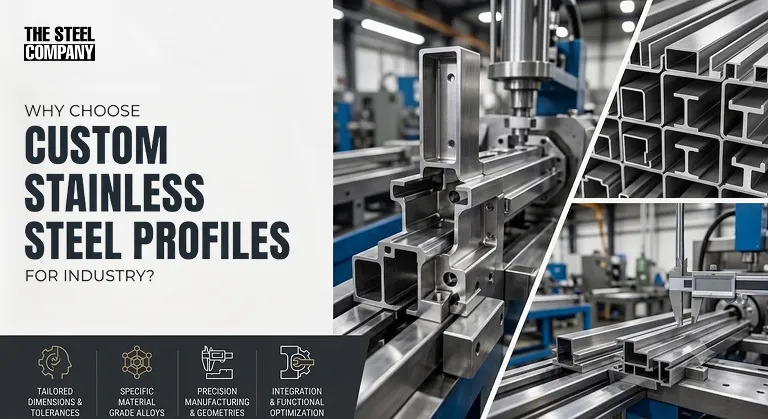
In industrial projects, small finishing details can affect how a finished product looks, fits, and performs. A standard profile may work for a simple installation. However, many projects need a specific size, shape, finish, or length. This is where Custom Stainless Steel Profiles become useful.
Instead of changing the project to fit an available profile, the profile can be produced around the project requirement. This can be helpful for architectural detailing, machinery areas, furniture components, wall and floor transitions, signage, elevators, and other fabrication work.
The Steel Company supplies stainless steel profiles in different forms, including U-Channels, L-Angles, T-Profiles and V-Groove profiles. It also offers custom fabrication based on drawings and required dimensions.
So, what makes custom profiles a practical choice for industrial work?
1. The profile can match the project requirement
Every industrial project does not have the same dimensions. A standard profile may be close to the required size, but even a small difference can create problems during installation. It may leave gaps, require extra cutting, or affect the final appearance.
Custom profiles allow the required dimensions to be considered before fabrication.
For example, a project may require:
- A specific profile width or depth
- A particular length
- A defined edge shape
- A specific thickness
- Holes or cut-outs
- A particular surface finish
- A profile made according to a drawing
The Steel Company states that its profiles can be produced to drawings, with cut-to-size options available. Its listed profile thickness range is 0.6 mm to 2.0 mm, with other options available on request.
As a result, custom fabrication can reduce the need to make unnecessary changes to the original design.
2. Different grades can suit different environments
Stainless steel is not one single material grade. The Steel Company lists SS 201, SS 304 and SS 316 for its profile range.
Choosing the grade should depend on where the profile will be used. This matters because stainless steel grades do not have the same resistance to every environment.
For example, the British Stainless Steel Association explains that 304 and 316 have different corrosion-resistance characteristics. The addition of molybdenum in 316 improves resistance to localised corrosion compared with 304, particularly in chloride-containing environments.
Therefore, grade selection should be considered alongside the site conditions.
| Grade | Where it may be considered |
| SS 201 | Projects where the selected material properties and environment are suitable |
| SS 304 | General architectural, interior and fabrication applications |
| SS 316 | More demanding environments where greater corrosion resistance is required |
Importantly, no stainless steel grade should be treated as completely corrosion-proof. Environment, design, surface condition and installation can all affect performance.
3. Custom shapes offer more design flexibility
Industrial profiles are not always required for structural purposes. They can also be used to create clean lines and controlled transitions.
The Steel Company offers U-Channels, L-Angles, T-Profiles, V-Groove profiles and custom shapes.
This gives designers and fabricators more options when a regular profile does not provide the required result.
For example, a stainless steel t profile can be used as a separation strip between surfaces. It can create a defined line while keeping the transition neat.
Similarly, L-Angles can help protect exposed edges, while U-Channels can be used for wall and floor transitions.
Instead of using one profile for every application, the shape can be selected according to the actual detail being finished.
4. Finishes can be matched with the overall design
Industrial does not always mean plain or unfinished. Modern commercial and architectural projects often use metal details as part of the visual design. A profile may need to match a wall panel, elevator interior, furniture element, signage or other stainless steel surface.
The available finishes listed by The Steel Company include:
- Mirror
- Hairline
- Brushed
- Satin
- Etched
- Vibration
- PVD colour finishes
The PVD colour options listed include gold, rose gold, bronze, black and champagne.
This is particularly useful when stainless steel decorative profiles are being used in visible areas.
For instance, a gold PVD profile can be selected to work with other gold-toned interior elements. A brushed or hairline finish may be more suitable where a softer metallic appearance is required.
5. Profiles can support cleaner edge detailing
Edges are often the areas where an installation looks unfinished. A wall panel may have an exposed edge. A flooring junction may need a clean transition. Furniture may require a narrow metal trim. These are small details, but they remain visible after the main installation is complete. This is one reason profiles are used.
The Steel Company describes its profiles as suitable for floor junctions, wall corners, door frames, bathroom detailing and furniture edges.
Therefore, a correctly selected profile can do more than add decoration. It can help cover an exposed edge, create a clear transition, or give two surfaces a more controlled finish.
6. Custom fabrication works with other manufacturing processes
A useful industrial profile needs to fit into the wider fabrication process. The Steel Company lists CNC cutting, bending, welding and laser etching among its fabrication capabilities.
This matters when the profile is part of a larger fabricated component.
For example, a profile may need to be:
- Cut to a defined length.
- Bent to a required shape.
- Welded to another stainless steel component.
- Finished or polished.
- Protected for transportation.
- Installed as part of the final assembly.
Outokumpu also notes that stainless steel can be shaped through processes such as bending, roll bending and roll forming, with process requirements depending on the grade and thickness.
As a result, custom profile production can be considered alongside the other fabrication requirements instead of treating the profile as a separate part.
7. The right thickness can be selected for the application
Thickness is another detail that should not be overlooked. The Steel Company lists profile thicknesses from 0.6 mm to 2.0 mm as standard, with other options available on request.
The required thickness depends on the profile design and its intended application. A decorative trim and a fabricated component may not have the same requirements.
For this reason, thickness should be discussed with the fabricator along with the dimensions, grade, finish and installation method.
This approach is more useful than selecting a thickness only because it is commonly available.
8. Custom profiles can include different types of stainless steel detailing
Not every project needs the same profile shape. A project may use more than one type of trim depending on the area. For example:
| Profile type | Typical purpose |
| U-Channel | Wall and floor transitions |
| L-Angle | Edge protection and finishing |
| stainless steel t profile | Separation between surfaces |
| V-Groove | Defined decorative detailing |
| Custom shape | Project-specific requirements |
The Steel Company lists these profile types within its available range and also provides custom shapes based on client requirements.
This gives the project team more control over how different areas are finished.
9. Flat bars can be useful for simpler detailing
Not every application requires a complex channel or shaped profile. stainless steel Flat Bars can be considered where a simple, straight metal element is required. They can work as part of fabricated assemblies or as a straightforward finishing component, depending on the project design.
The main benefit of a flat section is its simple form. It can be cut, finished and incorporated into a wider fabrication process without introducing a complicated profile shape.
However, the required width, thickness, grade and finish should still be specified before production.
This is especially important when the flat section needs to match other visible stainless steel components.
10. Custom profiles can support both function and appearance
A common mistake is to treat stainless steel profiles as purely decorative.
In practice, a profile can serve several purposes at the same time.
It may:
- Cover an exposed edge
- Create a transition between materials
- Separate two surfaces
- Protect a corner
- Add a decorative line
- Complete a furniture edge
- Form part of a fabricated assembly
This combination makes stainless steel profiles suitable for projects where both finish and practical detailing matter.
The Steel Company specifically lists applications across walls, floors, ceilings, bathrooms and furniture edges.
11. Surface protection helps during handling and installation
A good finish can easily be marked during transportation or installation if the visible surface is not protected.
The Steel Company states that PVC protective film is applied to visible faces of its profiles. It also recommends keeping the film in place until the final clean-down.
This is a simple but useful step.
During installation, profiles may be cut, moved, aligned and fixed into place. Keeping the protective film on the visible face helps reduce handling marks before the final stage.
The installation guidance also recommends dry-fitting lengths, checking alignment and deburring after cutting.
12. Custom orders can start with drawings or a cut list
Custom does not always mean that a complicated engineering document is required.
The Steel Company states that customers can send drawings, a cut list, room-by-room lengths or a simple sketch. The company can then confirm the grade, profile size and finish before returning a shop drawing where required.
This makes the ordering process easier to organise.
A project requirement can include:
Profile type → Grade → Dimensions → Length → Finish → Quantity → Application
Once these details are clear, the fabricator has a better basis for preparing the profile.
What should be checked before ordering custom profiles?
Before placing an order, it is worth preparing the basic project information.
| Requirement | What to provide |
| Profile | U, L, T, V-Groove or custom shape |
| Grade | SS 201, SS 304 or SS 316, based on application |
| Dimensions | Width, height, depth and thickness |
| Length | Standard or cut-to-size |
| Finish | Mirror, hairline, brushed, satin, etched or PVD |
| Quantity | Number of pieces or total length |
| Drawing | CAD drawing, shop drawing or simple sketch |
| Application | Wall, floor, furniture, elevator or other use |
Most importantly, the environment should be considered when selecting the grade. Stainless steel selection is not only about appearance. Corrosion resistance varies by grade and exposure conditions.
Why choose The Steel Company for custom profiles?
The Steel Company presents its stainless steel profile service around custom fabrication rather than only standard stock sizes.
Its stated capabilities include more than 100 profile styles, SS 201, SS 304 and SS 316 grades, multiple surface finishes, PVD colours, custom fabrication and CNC-based processing.
The company also lists more than 10 years of industry experience, a skilled engineering and fabrication team, CNC cutting, PVD coating and edge polishing capabilities.
Its homepage also states that it serves applications including elevators, facades, interior walls, signage and furniture detailing.
So, customisation is not limited to changing the length of a standard trim. The project can be discussed around the required profile shape, material grade, finish, dimensions and fabrication needs.
Final thoughts
Choosing a custom profile makes sense when a standard option does not properly fit the project. The right profile can help create cleaner edges, controlled transitions and consistent detailing. At the same time, the choice of grade and finish can be matched with the environment and overall design.
For industrial and architectural work, stainless steel profiles can therefore be specified around the actual requirement rather than forcing the project to fit an available size.
Whether the requirement is a Custom Stainless Steel Profiles solution, stainless steel decorative profiles, a stainless steel t profile, or stainless steel Flat Bars, the important step is to define the dimensions, grade, finish and application before fabrication.
The Steel Company offers custom stainless steel profile fabrication based on drawings, dimensions and finish requirements, making it possible to develop profiles for specific project details rather than relying only on standard forms.
