
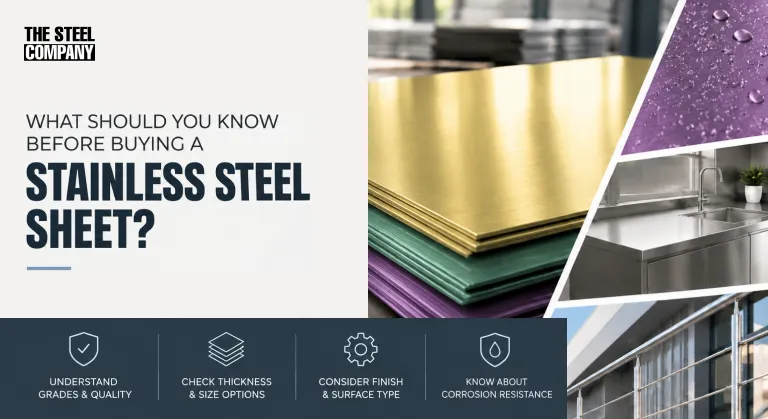
Buying a stainless steel sheet is not simply about choosing a size and placing an order. The right sheet depends on where it will be used, how it will be finished, and how it will be fabricated.
For example, a sheet for an indoor wall panel may have very different requirements from one used in a humid environment. Similarly, a plain brushed surface may work well for one project, while a PVD colour or decorative pattern may be better for another.
Before ordering, it is advisable to check some important details. The grade of steel, steel thickness, surface finish, size, color, fabrication, and protection are important parameters that influence the result.
The guide below details what to pay attention to when selecting stainless steel sheet, to make sure you choose the best option for your aims instead of relying solely on the look or the price of the product.
Start With the Stainless Steel Grade
The grade is one of the first things you should check. Different grades are suited to different conditions and uses.
The Steel Company works with grades including SS 201, SS 304, SS 316 and SS 430 across its stainless steel products. But the correct answer would depend on the project surroundings.
In many interior applications, 304 stainless steel sheet may be taken into consideration. It provides good resistance to corrosion and good mechanical properties and looks good.
The SS 316 grade should be taken into account in case the environment will be harsher, e.g., if the project is located near the sea or has high humidity levels.
SS 201 grade can be considered for some interior uses with less harsh environmental factors.
| Grade | Where it may be considered |
| SS 201 | Selected interior uses |
| SS 304 | General interior and architectural uses |
| SS 316 | Coastal or high-humidity environments |
| SS 430 | Selected interior and decorative uses |
However, grade should always be selected according to the actual project conditions. A lower-cost option is not necessarily the better choice if the environment requires higher corrosion resistance.
Check the Stainless Steel Sheet Thickness
Sheet thickness is very important for the fabrication and installation process. Thickness may also have an effect on the look of the sheet itself and also suitability for the intended use.
There is variation in the availability of stainless steel sheet thickness depending on the product and fabricating requirements. There are stainless steel products in different thickness ranges from 0.6 mm and above provided by The Steel Company for both decorative and fabricated purposes.
For PVD stainless steel fabrication, thickness range from 0.6 mm to 3.0 mm is standard while others are available according to the requirement.
So rather than picking thickness depending on the visual aspect of it, let’s see how the sheet is going to be used.
Ask:
- Is the sheet going to be used for walls and ceilings?
- Does it need bending or forming?
- Will it be fixed directly to a surface?
- Does the design require CNC cutting?
- Will it be used with a profile or frame?
- Does the finished piece need additional strength?
Most importantly, share the intended application with your supplier. This makes it easier to discuss a suitable thickness before production starts.
Choose the Right Surface Finish
A stainless steel surface does not have to look the same for every project. The finish can change the way light reflects from the sheet and can have a major effect on the overall appearance.
Common options include:
- Mirror
- Hairline
- Brushed
- Satin
- Etched
- Embossed
- Water ripple
- Hammered
- Decorative coloured finishes
A mirror finish gives a brighter and more reflective appearance. In comparison, brushed and hairline finishes give a more controlled surface with visible lines.
For feature interiors, decorative finishes can add more visual interest. A decorative stainless steel sheet can be used when a plain metal surface does not provide enough detail for the design.
Therefore, the finish should be selected along with the application, not as an afterthought.
Think About PVD Colour Before Ordering
Colour is another important consideration for decorative stainless steel work. The Steel Company offers Ti-PVD finishes in colours such as:
- Gold
- Rose Gold
- Bronze
- Black
- Champagne
- Blue
- Silver
PVD is applied as a vacuum-deposited coating. It provides a coloured surface while keeping the metal’s underlying character.
This can be useful for elevator interiors, reception areas, feature walls, signage, furniture details and retail interiors.
If colour consistency matters, ask for a sample before approving a larger order. This gives the project team a chance to review the actual finish rather than relying only on a screen image or colour reference.
Consider Decorative Sheets for Feature Areas
A plain sheet is not always the best option for a visible interior. Decorative stainless steel surfaces can create depth, movement and reflection.
For example, a water ripple sheet has a flowing surface pattern. The texture catches light differently across the panel, creating a changing appearance as people move around the space.
Water ripple sheets can be used for:
- Feature walls
- Lift interiors
- Ceiling panels
- Column covers
- Counters
- Furniture-facing panels
A hammered finish creates a different effect. Its textured surface gives the metal more visual depth and works well when a flat surface feels too plain.
The important point is to match the pattern with the rest of the interior. A strong texture can become the main feature of a space, so it should work with the lighting, colours and surrounding materials.
Compare the Stainless Steel Sheet Price Properly
The stainless steel sheet price is important, but it should not be the only factor used to compare suppliers.
Two sheets may look similar in a quotation but have different specifications. The final cost can depend on several details.
| Price factor | Why it matters |
| Grade | Different grades have different material properties and costs |
| Thickness | More material generally affects the cost |
| Finish | Mirror, brushed and decorative finishes can have different pricing |
| PVD colour | Coloured finishes require additional processing |
| Sheet size | Larger or custom sizes can affect fabrication |
| Cutting | CNC or laser cutting adds processing requirements |
| Bending | Formed parts require additional fabrication |
| Etching | Custom logos and patterns add processing |
| Quantity | Larger project quantities may affect the quotation |
For this reason, ask for a quotation based on the complete specification. Comparing only the price per sheet may not give you a true comparison.
Check Sheet Size and Cutting Requirements
Before ordering, prepare the sizes you actually need. Plan out the size required before placing an order. It is particularly crucial for those with more than one panel or fabricated part involved in their project.
If possible, submit a cut list or a drawing to the supplier. The Steel Company will be able to manufacture according to drawings, measurements per room, cut list or even just sketching of custom needs.
This will aid in defining:
- Size of sheets needed
- Amount required
- Cutouts
- Bends
- Edge finishes
- Profile requirements
- Direction of finish
- Areas for installation
Planning these details early can also reduce mistakes during fabrication. For larger projects, it is useful to label each piece according to its location. This makes installation easier when several panels have similar sizes.
Check Whether You Need Custom Fabrication
Sometimes a standard flat sheet is enough. In other cases, the sheet needs to be cut, bent, welded or finished to a specific design.
The Steel Company provides in-house fabrication services that include CNC cutting, forming, welding, polishing, edge finishing and laser etching.
This means a project can be developed from the sheet stage through to a more finished component.
Custom fabrication can be useful for:
- Elevator panels
- Wall cladding
- Reception features
- Furniture components
- Signage
- Feature panels
- Architectural metalwork
If your design already has drawings, share them before ordering the material. It allows the supplier to check the grade, thickness, finish and fabrication requirements together.
Do Not Ignore Stainless Steel Profiles
A sheet is only one part of many interior metal projects. Edges and junctions also need attention.
Stainless steel profiles can be used around wall corners, floor junctions, door frames, furniture edges and transitions between materials.
The Steel Company offers more than 100 profile designs, including U-Channels, L-Angles, T-Profiles and V-Groove profiles.
These profiles are available in SS 201, SS 304 and SS 316, along with finishes such as mirror, hairline, brushed, satin and etched. PVD colours are also available.
For example, an L-angle can help protect a tile or panel edge, while a T-Profile can create a clean separation between two surfaces.
So, when planning a sheet installation, check whether profiles are also needed. Ordering both parts together can make it easier to maintain the same grade, finish and colour across the project.
Think About Surface Protection During Installation
A finished stainless steel surface can be damaged if it is handled roughly during fabrication or installation.
The Steel Company’s stainless steel products can be supplied with protective PVC film on visible faces. This helps protect the surface during handling and installation.
However, protection still needs to be handled correctly. Keep the protective film in place until the installation and final clean-down are complete. During cutting and fabrication, avoid dragging sheets across rough surfaces.
For decorative sheets, this is even more important because scratches or dents can be more noticeable on patterned and coloured surfaces.
Also, do not remove the protective film too early. Removing it after the surrounding work is finished helps reduce the chance of surface damage.
Check Fabrication and Installation Compatibility
Before buying a stainless steel sheet, make sure the planned fabrication method is suitable for the selected product and finish.
Depending on the product, stainless steel can be processed through methods such as:
- CNC cutting
- Laser cutting
- Bending
- Folding
- Welding
- Edge polishing
- Laser etching
- Pattern forming
However, decorative and PVD finishes need careful handling. Fabrication should be planned so that visible surfaces remain protected.
For installation, dry-fit pieces before final fixing. This helps check the joints, alignment and orientation.
Where the sheet has a visible grain, keep the grain direction consistent between adjoining pieces. This small detail can make a noticeable difference to the finished installation.
Choose a Supplier That Can Handle Your Specification
Choosing the right stainless steel sheet supplier is not only about finding someone who sells stainless steel.
The supplier should be able to clearly discuss the material grade, thickness, finish, colour and fabrication requirements.
For a custom project, it is also useful if the supplier can work from drawings and provide samples where required.
The Steel Company supports custom stainless steel fabrication along with sheets, profiles and decorative finishes. Its capabilities include CNC cutting, bending, welding, polishing and Ti-PVD finishing.
Before placing an order, give the supplier as much project information as possible. A drawing, cut list, finish reference and quantity can make the quotation more accurate.
What to Share When Requesting a Quote
A clear enquiry can save time for both the buyer and supplier. Instead of asking only for the price of a sheet, share the following details:
| Information | Example |
| Grade | SS 304 |
| Thickness | Required gauge |
| Size | Sheet or cut-to-size dimensions |
| Finish | Brushed, mirror, hairline, etc. |
| Colour | Gold, bronze, black, etc. |
| Quantity | Number of sheets or components |
| Fabrication | Cutting, bending, etching, etc. |
| Application | Wall, lift, furniture, signage, etc. |
| Drawing | CAD drawing, shop drawing or sketch |
This gives the supplier a clearer picture of what you need. If the project uses several finishes or sizes, list them separately. It reduces confusion when the quotation is prepared.
Final Checklist Before You Buy
Before confirming your stainless steel order, go through this quick checklist:
- Confirm the grade required for the environment.
- Check the required stainless steel sheet thickness.
- Decide on the surface finish.
- Confirm the sheet dimensions.
- Check whether PVD colour is required.
- Consider whether a decorative stainless steel sheet is more suitable.
- Ask whether cutting, bending or etching is needed.
- Check if stainless steel profiles are required.
- Check the protective coating and packaging.
- Request samples if color and consistency matter to you.
- Quote comparison should be made on the basis of the complete specification, and not the price of stainless steel sheets alone.
- Check the manufacturing and delivery schedule prior to installation.
Make the Choice Based on the Whole Project
The right stainless steel sheet is the one that fits the complete project requirement. Grade, thickness, finish, size and fabrication all need to work together.
For a simple interior application, a standard grade and finish may be enough. For a high-visibility space, you may need a PVD colour, decorative texture or custom fabrication.
Likewise, a project with several edges and junctions may need matching stainless steel profiles alongside the sheet.
The best approach is to decide the specification before you compare prices. Once you know the grade, thickness, finish, size and fabrication requirements, it becomes much easier to compare options and avoid unexpected changes later.
Steel Company provides us with stainless steel sheets, sections, and PVD fabrication of any type. It is possible to share your drawings, cutting list, preferred finish and amount of steel you require for specifying the proper type of steel.
